

Lesson 4.Refrigeration Circuit Components I: Compressors
February 9, 2026Lesson 3.Refrigerants
February 9, 2026Welcome to this lesson! Start by watching a recap video of this lesson.
Click on the gear icon to choose subtitles of your preferred language.
Ancillary components play a crucial role in ensuring efficient, stable, and safe operation of heat pump systems. While compressors, heat exchangers, and expansion devices are often emphasized, supporting components such as fans, pumps, flow and safety devices, and hydraulic stabilizers have a direct impact on system performance, energy consumption, and reliability [1],[2],[3]. Advances in component design and control strategies are aligned with broader industry trends toward higher system efficiency, variable-speed operation, and smart building integration [4],[5],[6]. There are the key ancillary components in four main categories:
- Fans and airflow control devices;
- Circulating pumps and hydraulic system integration;
- Flow switches and control safety devices;
- Expansion tanks and inertia tanks for hydraulic stability.
8.1 Fans and airflow control devices
Fans are essential for driving airflow through heat exchangers in air-source heat pumps, ensuring adequate heat transfer between the refrigerant and ambient air. Both axial and centrifugal fans are used, depending on the application. Axial fans dominate outdoor units due to their high flow capacity and compactness, whereas centrifugal fans are common in indoor air-handling units where higher static pressure is needed [7].
Modern systems increasingly employ EC (electronically commutated) fans, which offer variable-speed operation, improved efficiency, and compatibility with smart controls [8]. EC fans typically achieve motor efficiencies of 80–90%, significantly higher than traditional shaded-pole or PSC motors [9]. Precise airflow modulation allows for optimized heat exchanger performance, lower noise levels, and frost control under part-load conditions [10].
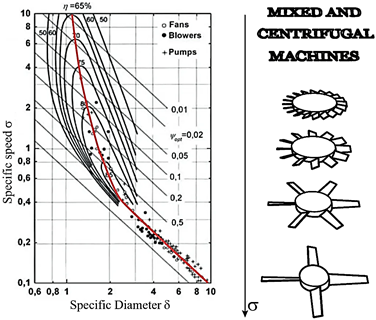
Figure 8‑1. Specific speed vs specific diameter graph with efficiency contours and machine type illustrations for mixed and centrifugal machines [11]
Airflow control devices—such as guide vanes, variable-speed drives, louvers, and air dampers—are used to direct and modulate flow, especially in defrost control and multi-mode operation. Innovations include intelligent fan algorithms that adjust speed based on coil temperature and ambient conditions, reducing energy use while maintaining capacity.
Industry trends
Integration of variable-speed EC fans with inverter-driven compressors enables coordinated operation for maximum seasonal efficiency (SCOP/SEER), especially in residential and commercial air-source heat pumps.
A comparative analysis of air-to-water heat pumps with inverter-driven versus on-off control confirms the higher seasonal efficiency of inverter-based systems. Using the UNI/TS 11300-4 bin method under actual climate conditions, the results show that inverter units achieve SCOP values at least 10% greater than those of fixed-speed models. This efficiency gain is largely attributed to the inverter compressors’ ability to adjust output according to fluctuating heating demands, minimizing cycling losses and improving performance under partial loads.
These conclusions are reinforced by additional studies, which report that variable-speed systems can improve COP by 20% to 30% during moderate weather compared to conventional on-off systems. Further simulations suggest that inverter-driven models can deliver annual energy savings of 10% or more, especially in brine-to-water setups where adapting to changing loads is essential.
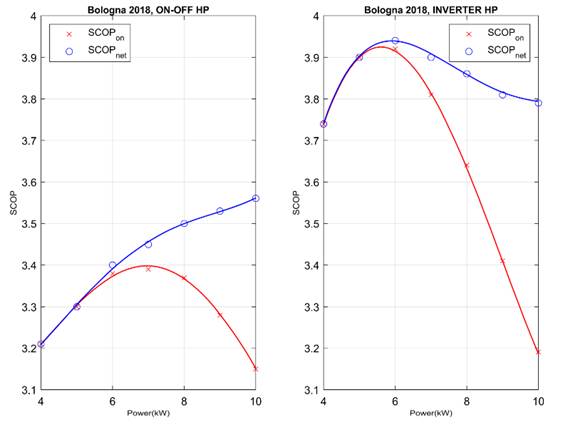
Figure 8‑2. The SCOP of an Air Source Heat Pump: SCOP for on-off HP and for inverter HP [12]
8.2 Circulating pumps and hydraulic system integration
Circulating pumps are responsible for moving thermal energy between the heat pump unit and the heating/cooling distribution system (e.g., radiators, underfloor heating, fan coils). Proper pump selection and control are crucial for hydraulic balance, temperature stability, and overall system performance [13],[14],[15].
Modern heat pump systems increasingly use variable-speed circulation pumps with ECM (electronically commutated motor) technology, offering significant energy savings compared to constant-speed models [16]. Advanced controllers can adjust pump speed dynamically based on differential pressure, temperature, or flow demand, ensuring stable operation under varying load conditions [17].
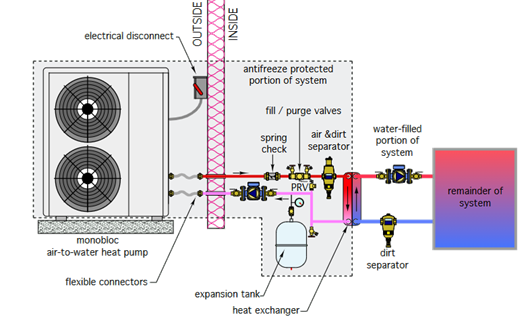
Figure 8‑3. Diagram of an air/water heat pump installation circuit showing different hydraulic functions and color-coded piping for safety [18]
Hydraulic integration involves the correct placement of pumps relative to hydraulic separators, buffer tanks, and distribution circuits to avoid short-circuiting, unwanted mixing, and pressure imbalances. In multi-source or multi-load systems, primary/secondary pumping arrangements or decentralized pumping strategies are used to ensure proper flow distribution [19].
Practical aspects and trend
Undersized pumps may cause insufficient flow and compressor short-cycling, while oversized pumps lead to unnecessary electrical consumption and noise.
There is a growing emphasis on digital pump control and integration with BMS (Building Management Systems) to enable predictive operation, remote diagnostics, and real-time flow optimization.
8.3 Flow switches and control safety devices
Flow switches and related safety devices protect heat pumps from malfunction and damage caused by low or no flow conditions, air entrainment, or freezing risks. Flow switches (paddle, turbine, or electronic types) ensure that sufficient fluid flow is present before the compressor is allowed to start [20],[21]. If flow drops below a threshold, the switch sends a signal to the controller to shut down or lock out the unit, preventing damage to heat exchangers or compressors.
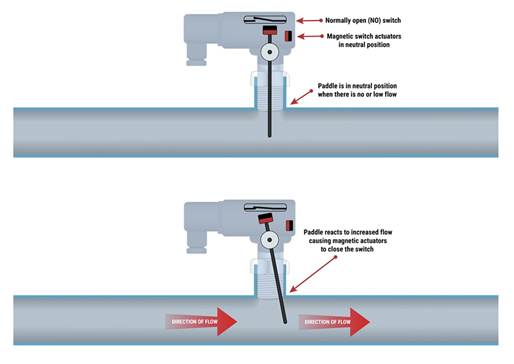
Figure 8‑4. Diagram of the operation of a paddle type flow switch responding to fluid flow in a pipe
Other safety devices include:
- Pressure relief valves – protect against overpressure events;
- Low and high-pressure switches – safeguard the refrigerant circuit;
- Freeze protection sensors – prevent coil or heat exchanger freezing during low-load operation;
- Differential pressure switches – detect clogged filters or blockages in the hydraulic loop [22],[23].
Electronic flow sensors are increasingly replacing mechanical types due to higher accuracy, faster response, and integration with digital control systems [24]. They are particularly valuable in variable-speed systems, where flow rates change dynamically.
Trend: Integration of flow and safety devices into smart control platforms enhances fault detection, predictive maintenance, and compliance with modern safety standards (e.g., EN 378, ISO 5149).
8.4 Expansion tanks and inertia tanks for hydraulic stability
Expansion tanks are critical for accommodating thermal expansion of water in closed hydraulic circuits, preventing excessive pressure build-up as water temperature rises. A membrane or bladder tank partially filled with air or nitrogen absorbs volume changes, keeping system pressure within safe limits [25].
Inertia tanks (or buffer tanks) provide hydraulic stability by decoupling the heat pump from the distribution circuit. They increase system water volume, reducing temperature fluctuations and compressor short-cycling, especially under low-load or variable-flow conditions. Correct sizing is essential: too small a tank will not stabilize operation effectively, while an oversized tank increases system costs and response times [26],[27].
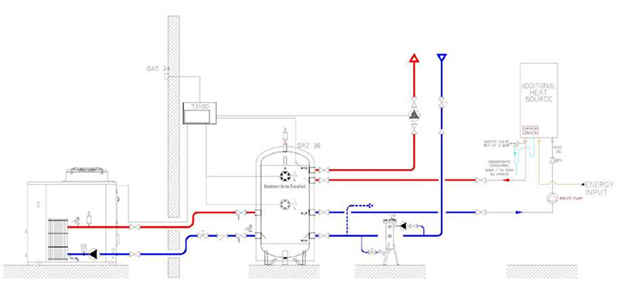
Figure 8‑5. Diagram of a hybrid heat pump system with one buffer tank and one boiler in a central heating circuit
Modern designs combine expansion and buffer functions in integrated hydraulic modules, often preassembled for quick installation in residential and commercial systems [28]. In large installations, multiple inertia tanks or stratified buffer tanks may be used to improve temperature layering and system control [29].
Trends
Use of intelligent control algorithms to optimize buffer tank charging and discharging, combined with low-temperature heating systems, improves seasonal performance factors and grid interaction.
8.5 Review Questions
- List the main ancillary components found in a heat pump system and briefly describe the role each plays in ensuring stable and efficient operation.
- Explain the function of fans in air-source heat pumps and discuss the difference between axial and centrifugal fans in terms of airflow and pressure characteristics.
- Describe the purpose of circulating pumps in water-to-water or air-to-water heat pumps. How do variable-speed pumps improve system performance?
- Define the function of an expansion tank and explain why it is essential for maintaining safe operating pressure in closed hydraulic circuits.
- Why do inverter-controlled EC fans and variable-speed compressors increase seasonal performance (SCOP) compared to fixed-speed systems?
- Explain how frost formation on an air-source heat pump evaporator can be minimized by proper fan control and airflow management.
- A heat pump frequently short-cycles due to fluctuating flow rates in the heating loop. What role could an inertia (buffer) tank play in resolving this issue?
- Describe how smart integration of flow switches and pressure sensors contributes to predictive maintenance and overall system safety in modern heat pumps.